
Article by Vincent Soubiron, published in the Italian magazine Ski&Wake Magazine. Photos by @merlinlzn.

For decades, elite slalom coaching has largely revolved around technique: body position, leverage, angle, handle control, timing, connection. And of course, those things matter, no doubt about that.
But after years of coaching world-class athletes across different generations, I have progressively become convinced of something: modern shortline slalom is no longer only a technical challenge. It is a neuro-motor challenge.
At 10.25 m and beyond, the sport simply moves too fast for conscious control alone. The best skiers are not necessarily those with the “perfect movement.” They are often the ones whose nervous system remains the most organized inside chaos.
The Problem With Repetition
Traditional training models rely heavily on repetition: same rope, same speed, same rhythm, same intentions. Repetition is useful, no argument about that. But it can also create fragile athletes. How come? Because the skier slowly becomes dependent on a predictable environment. The nervous system starts memorizing conditions rather than developing adaptability.
And slalom, especially at elite level, is never perfectly stable: water changes, timing, gates, wind, rhythm and even emotional states change. The question then becomes: can the skier stay organized when the environment stops cooperating? That is where neuro-motor training becomes fascinating.
Training Adaptation Instead of Memorization
One concept I frequently use with elite skiers is variability. Don’t get me wrong, I know how hard it is for a skier to change his/her training routine. It takes trust.
During a six-pass set, I may constantly change rope length and speed without announcing it. Most of the time, the skier will not know the rope length because I use a single-color slalom rope. They only realize the setup once they visually detect it on the water. That detail matters far more than people think. For example, a skier might run:
- 11.25 m at 58 km/h,
- then immediately 18.25 m at 46 km/h,
- then 14.25 m at 55 km/h,
- followed by 10.25 m at 58 km/h,
- then back to 18.25 m at 37 km/h,
- finishing the set at 12 m and 58 km/h.
The brain is no longer allowed to simply “play back a recording.” It must observe, recalibrate, reorganize and adapt. That is a neurons volcano right there! This dramatically changes the quality of attention. The skier becomes perceptually active instead of mechanically repetitive.
Why Long Rope Matters for Shortline
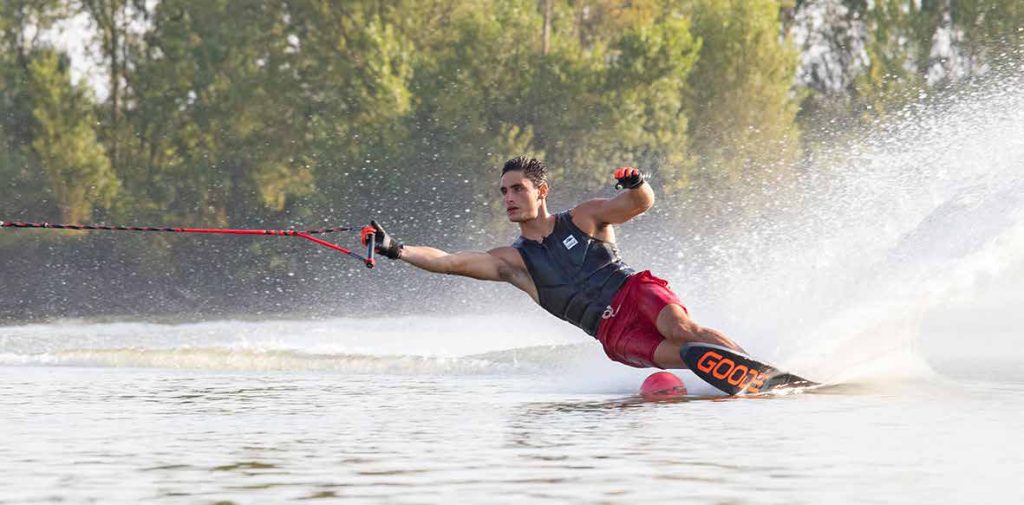
One of the biggest misconceptions in slalom is that long line and shortline are completely different worlds. Mechanically? Yes. Neurologically? Not always.
At 18.25 m, the wakes are larger and softer. At 10.25 m, they are smaller but significantly harder and faster. Yet both create perturbations in balance, timing and body organization.
Curiously, when elite shortline skiers return to 18.25 m after years away from it, many suddenly struggle again and look goofy. Their timing becomes messy, over-reactions surge and parasitic movements creep in. Because long line exposes the nervous system differently. The environment becomes more spacious, less constrained, and many hidden compensations suddenly reappear. That makes long rope an extraordinary diagnostic and neuro-motor development tool.
One of the Most Important Skills in Slalom: Not Overreacting
This may sound strange in a sport associated with speed and intensity. But one of the greatest separators at elite level is often the ability not to panic after perturbation.
Most missed buoys do not come from the initial mistake itself. They come from the correction afterward. Yes, think about it. It is like everything in life: it’s not the problem itself that matters, it’s how we react that turns it into one.
A small collision occurs and then comes the drama: the shoulders attack, arms pull, hips freeze, vision narrows and the skier tries to “save” aggressively. The nervous system enters survival mode. Sometimes, the over-correction becomes more destructive than the original error. Funny, isn’t it?
Slalom Is Becoming More Ecological
Modern slalom is not just about reproducing a technical model. It is about:
- adaptability,
- perception,
- stability under perturbation,
- efficient self-organization.
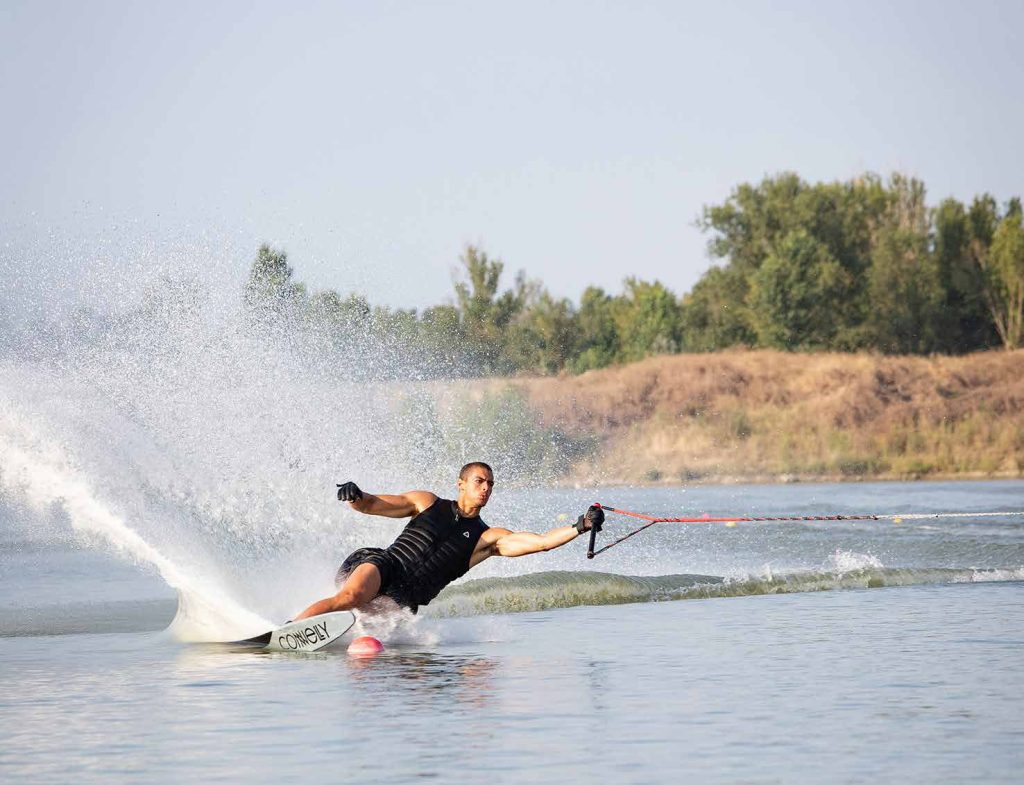
The nervous system must constantly solve moving problems in real time. That changes coaching. Sometimes the objective is no longer: “Repeat the perfect movement.” Sometimes the objective becomes: “Maintain organization while the environment becomes unstable.” That is a very different philosophy.
Beyond Mechanics
I still love technical coaching. Technique matters enormously, and designing a singular technique for each skier is one of the most fascinating parts of coaching.
But increasingly, I believe the future of elite slalom development will involve:
- neuro-motor adaptability and perceptual training,
- cognitive flexibility and environmental variability,
- without forgetting emotional regulation under pressure.
Because at the highest level, performance is rarely just mechanical. It is neurological, and perhaps it always has been, even if we have not expressed it enough and we were too focused for too long on the technical side only.
And perhaps the most important question for modern skiers is no longer: “Can you execute the movement?” But rather: “Can your nervous system remain fluid inside uncertainty?”
Everything discussed in this article is not only for elite skiers. I just took an example with elite skiing as it’s easier to represent: many of them have insanely great technique, and yet only a few of them are consistent running 41 off. These concepts can benefit all levels of slalomers working toward improvement. The drills simply evolve with the level.
Join our training programs and access an extensive range of slalom drills designed to help you reach your highest potential. Contact us.
Coach Vinney
Sponsors: Connelly, Slines, Miami Nautique, Procalp, Pro Ski Simulator